
The Strategy Stack
Three integrated capabilities.
One coherent architecture for U.S. grand strategy.
Ends. Ways. Means.
The architecture of coherent grand strategy.
"Grand strategy is the calculated relationship of means to large ends."
— John Lewis Gaddis
The word calculated is doing real work there — it implies tradeoffs, coherence across time, and the hard discipline of relating what a nation has to what it seeks to achieve. The United States does not lack the scholarship, the institutions, or the expertise to do this well. What it lacks is the infrastructure to synthesize that abundance into coherence at the pace contemporary competition demands.
The Strategy Stack is that infrastructure. It is a research-and-learning architecture built on the logic of ends, ways, and means — the foundational framework of strategic thought — and powered by AI as an instrument for lifting the fog of complexity, clarifying interdependencies, and accelerating disciplined reasoning.
The National Power Index measures the means — building a structured, auditable, evidence-based picture of U.S. national power across every domain of competition. The Gaming Engine translates those measured means into explored ways — stress-testing strategic options under uncertainty before they are committed to in the real world. Strategic AI Leadership cultivates judgment about ends — developing the human capacity to ask the right questions, interpret what the data reveals, and lead with coherence, responsibility, and long-term purpose.
These are not three parallel products. Each produces outputs the other two require. Without measured means, simulations begin from untested assumptions. Without simulation, the measurement framework never faces adversarial pressure. Without educated judgment, neither data nor simulation can be translated into purposeful action. Together, they constitute something that has not existed before: a complete, AI-enabled architecture for strategic reasoning at scale.
AI in the Strategy Stack is not strategic authority. It is epistemic infrastructure — an instrument for better reasoning within compressed timelines, so decision-makers can slow down at the moment that matters most: judgment.
National Power Index
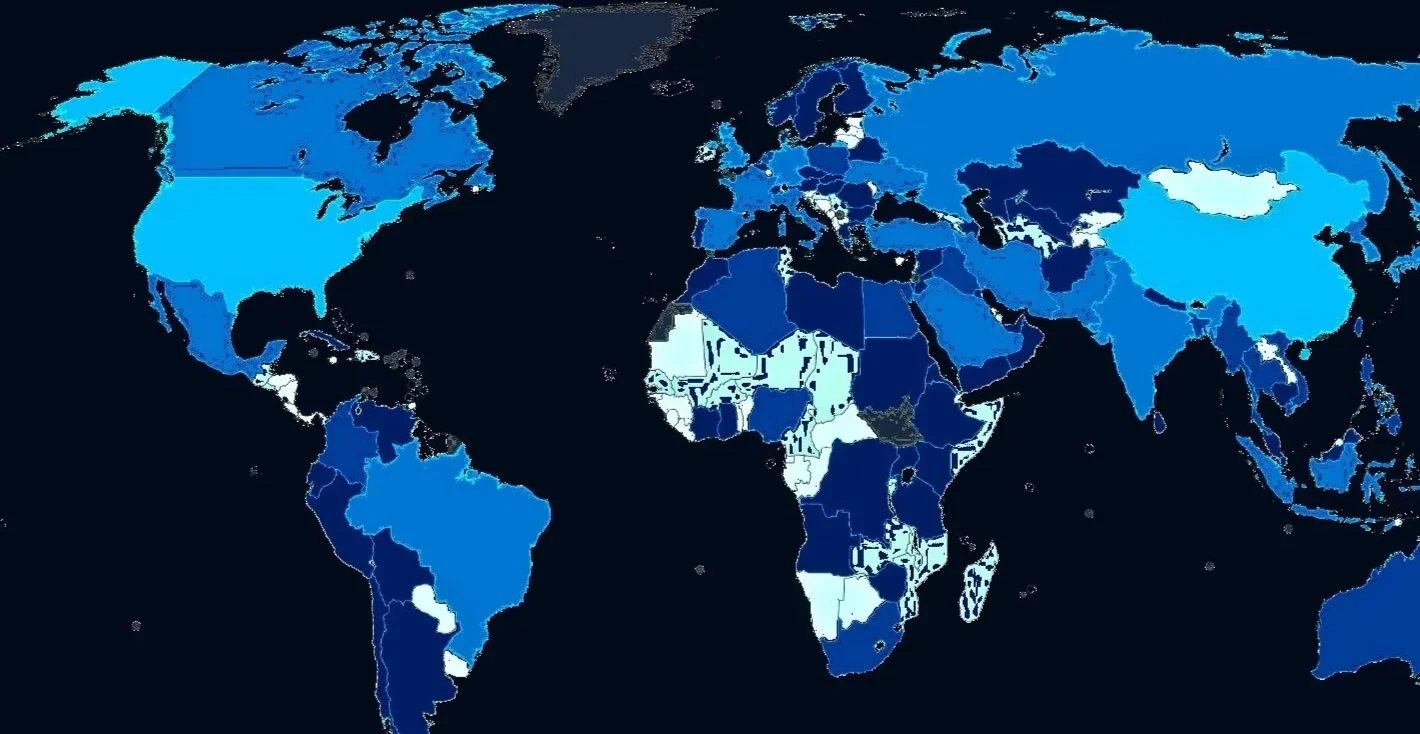
Measuring national power across every domain of competition.
Strategy cannot be calculated from assumptions. It must be grounded in evidence - a structured, shared, and auditable understanding of what the United States and its competitors actually possess across the full spectrum of national power. The National Power Index (NPI) is that foundation.
The NPI is built on an expanded DIMEFIL-DC framework: Diplomatic, Informational, Military, Economic, Financial, Intelligence, Legal, Digital, and Cultural. These nine domains capture the full range of instruments through which nations compete, coerce, and cooperate - and they are designed to talk to each other. Too much existing power measurement treats these domains in isolation, producing analyses that are rigorous within a silo but blind to the interdependencies that define how grand strategy actually operates.
What makes the NPI distinct is its conception as an ontology before it is an index. Rather than collapsing national power into a single composite score, which implies false precision, the NPI is designed as a structured, living map of evidence and causal claims. It bridges qualitative and quantitative data, supports competing analytical interpretations, preserves the provenance of every claim, and is built for interoperability across institutions. AI enables this by maintaining living bibliographies, tracking evolving indicators, reconciling different analytical vocabularies across research communities, and surfacing contradictions rather than hiding them.
What the NPI delivers:
A multi-domain, evidence-based assessment of national power across DIMEFIL-DC
Structured scenario analysis of how power configurations shift under different strategic conditions
Long-term trend tracking across all nine domains of competition
An auditable, shareable evidence substrate that feeds directly into the Gaming Engine
A common analytical language for use across government, academia, and the private sector
The NPI does not tell strategists what to do. It tells them what they are working with - clearly, rigorously, and in a form that can be contested, updated, and shared across the institutions that need to act on it together.
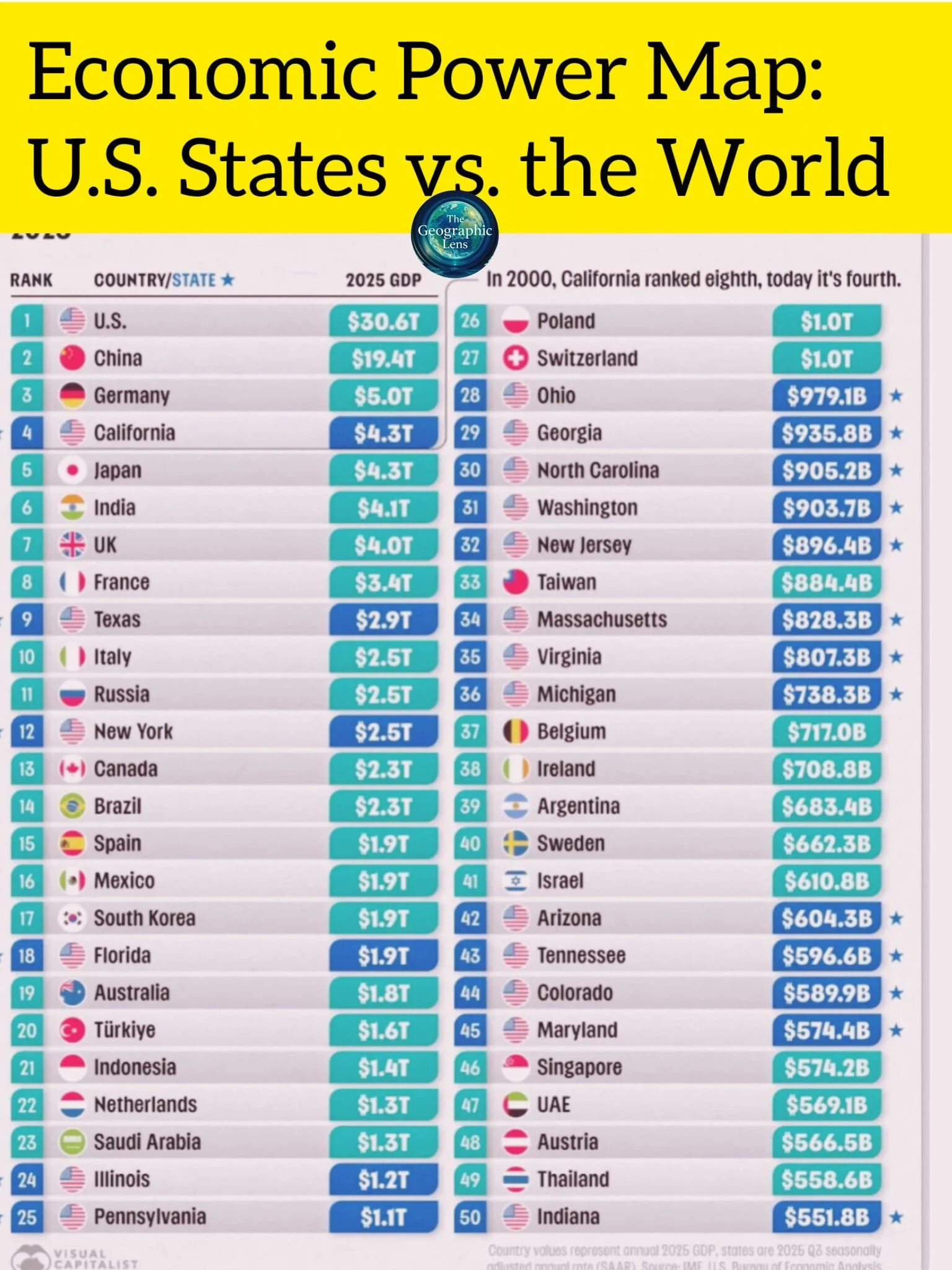
Strategic Simulation & Gaming

"Strategy is only as good as the insight behind it. SAGE builds that insight through structured analysis, real-world data, and hands-on experimentation."
— Center for the Application of Grand Strategy
Stress-testing strategy before the world does it for you.
Strategy that has never been tested is not strategy - it is intention. The history of U.S. strategic failure is not primarily a history of bad ideas. It is a history of untested assumptions, unexamined interdependencies, and strategies that looked coherent in isolation but fractured under the friction of a complex, adversarial world. SAGE exists to close that gap: before decisions are made, not after.
SAGE (Strategic Advisory and Guidance Engine) is CAGS's AI-powered decision-support platform, purpose-built to integrate experiential simulation with structured analytical frameworks and rigorous scenario design. Where static analysis stops, SAGE begins: surfacing the second and third-order effects of strategic choices, revealing where coordination breaks down, and generating cumulative learning across teams and institutions over time. Every scenario begins from the National Power Index's evidence substrate, ensuring that starting conditions are grounded in measured reality rather than assumed ones.
SAGE operationalizes the full instruments of national power, mapping authorities, budgets, roles, and institutional dependencies across government and the private sector. It makes visible the coordination challenges that most strategic planning glosses over. SAGE does not model war. It models the full complexity of strategic competition: economic interdependence, diplomatic signaling, information dynamics, legal constraints, alliance cohesion, and the cultural narratives that shape political will across every domain.
The AI-powered decision-support layer combines retrieval-augmented generation, knowledge graphs, optimization models, and scenario planning to surface options, map consequences, and support rigorous comparison across strategic choices. The goal is not to produce a recommended course of action. It is to produce better-informed, more clearly reasoned human judgment, and to build the analytical habits that make that judgment more reliable over time.
SAGE also serves as a live training environment for professional military education, interagency coordination exercises, and institutional strategy development, connecting the analytic rigor of the National Power Index to the experiential learning that turns frameworks into practice.
What SAGE delivers:
Scenario-based stress-testing of strategic options across multi-domain environments
Identification of interdependencies, coordination gaps, and second-order effects
Repeatable, comparable experimentation enabling cumulative learning over time
AI-powered decision-support that augments, not replaces, human judgment
Direct integration with NPI data for evidence-grounded scenario initialization
Application across interagency coordination, alliance strategy, and great-power competition scenarios
A live training environment for professional education and institutional capacity-building
The measure of a good simulation is not realism. It is insight. SAGE is designed to produce the kind of insight that only comes from watching your strategy encounter the world: where it holds, where it breaks, and what that tells you about what you actually need.

Strategic Education & Training
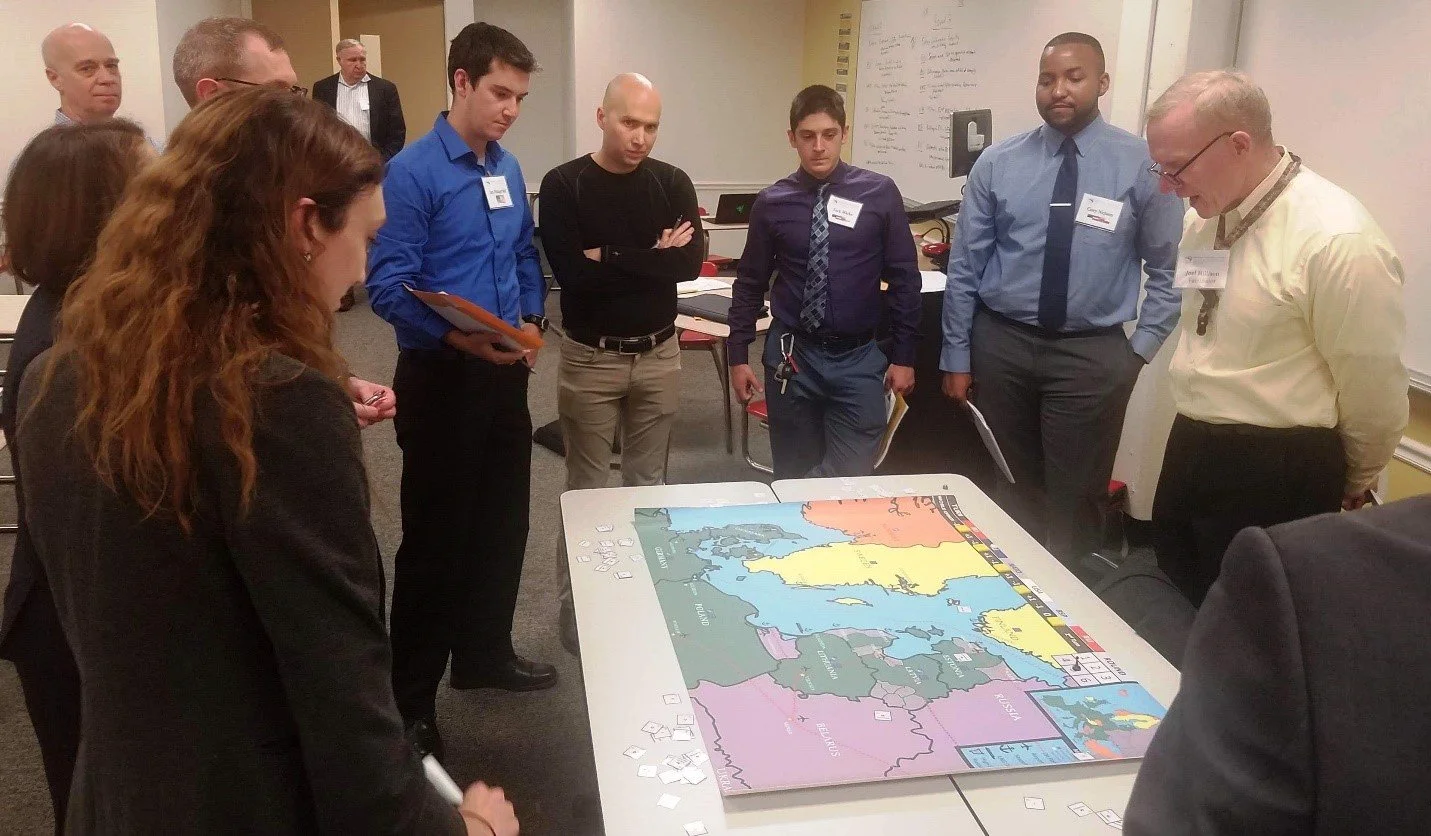
Building the leaders who can turn analysis into action.
Data without judgment is noise. Simulation without wisdom is theater. The Strategy Stack's third layer exists because neither the National Power Index nor the Gaming Engine can do their jobs without decision-makers who know how to use them — leaders who combine the classical discipline of grand strategic thinking with the fluency to understand, direct, and govern AI-enabled analysis responsibly.
This is a new kind of capability gap. The most consequential decisions in U.S. national security are being made by leaders who were educated before AI became a defining feature of the strategic environment. They are not unintelligent or unserious. They are operating with frameworks that were built for a different information environment — one where the synthesis task was bounded enough that a well-trained mind and a good team could manage it without dedicated infrastructure. That world is gone.
Strategic AI Leadership develops the capacity to navigate the world that replaced it. CAGS's executive-level programs fuse classical strategic reasoning — ends-ways-means thinking, the logic of grand strategy, the discipline of Clausewitz, Gaddis, and Kennan — with rigorous AI fluency: how models function, how they fail, how they should be governed, and how to extract insight from AI-enabled analysis without surrendering judgment to it. Programs are built for senior decision-makers across the interagency, the uniformed military, academia, and the private sector.
The educational philosophy is experiential. Participants do not just study strategic concepts — they apply them in simulation environments drawn directly from the Gaming Engine, using NPI data to ground their analysis and AI tools to support their reasoning. The goal is not awareness. It is the kind of practiced judgment that holds under pressure.
What Strategic AI Leadership delivers:
Executive programs integrating classical grand strategic thinking with AI fluency
Scenario-based, experiential learning grounded in NPI data and Gaming Engine environments
Frameworks for responsible AI governance in high-stakes decision environments
Development pathways for the next generation of strategic analysts and practitioners
University partnerships and continuing education programs for senior leaders
Curriculum designed for interagency, military, academic, and private sector audiences
Grand strategy must ultimately be practiced by people. The Strategy Stack builds the data, the simulations, and the analytical architecture to support those people — but this layer is where the architecture becomes human. It is where analysis becomes judgment, and judgment becomes action.
“ChatGPT and its successors will not replace strategic judgment. But they will become the operating environment within which all strategic judgment is made.”
— Henry Kissinger, Eric Schmidt, and Daniel Huttenlocher